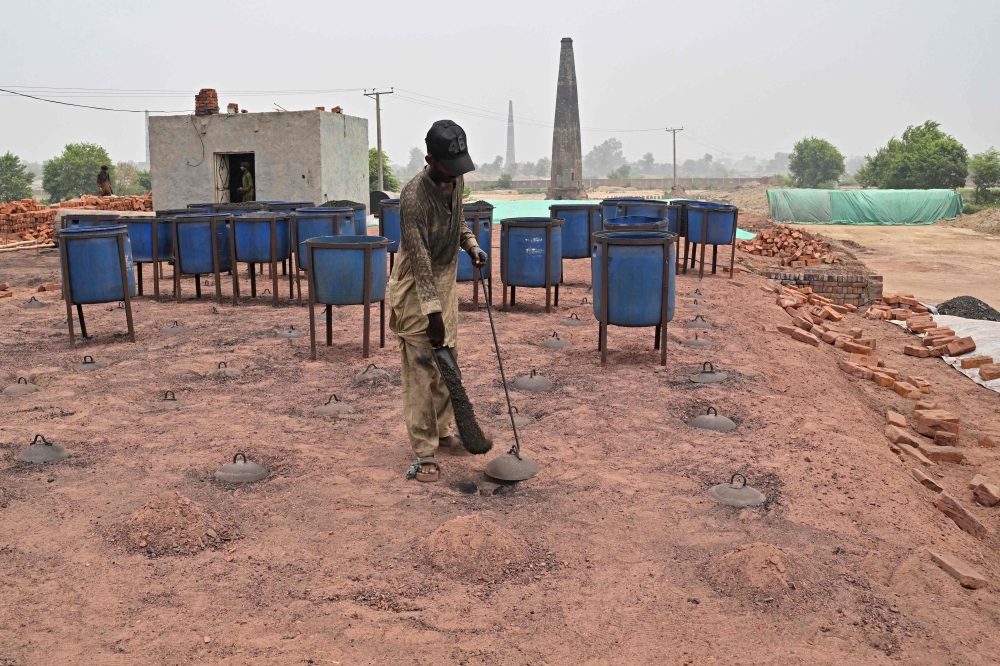
Pakistan’s brick kiln workers are caught between two sources of unrelenting heat — and the situation is growing more dangerous every year. Across the kilns of Sheikhupura district in Punjab province, labourers like 35-year-old Abid Hussain spend long hours crushing coal through small holes in the ground, feeding fiery chambers burning at over 1,000 degrees Celsius, while the Pakistani summer sun beats down from above. As climate change pushes temperatures well past 40 degrees Celsius with increasing regularity, these workers — already among the most vulnerable in the country — face escalating health risks, financial entrapment, and a near-total absence of regulatory protection.
Sheikhupura’s Brick Kiln Industry Has Long Relied on Workers With Nowhere Else to Turn
Rooted in the industrial heartland of Pakistan’s Punjab province, Sheikhupura has for decades been a central hub of the country’s brick kiln sector. This is not a small industry: nationwide, more than 18,000 brick kilns employ a total of over one million people, according to 2018 data compiled in a Climate and Clean Air Coalition report. Sheikhupura sits at the geographic and economic core of this workforce, drawing in labourers from surrounding areas who depend on the sector as one of few available sources of steady, if meagre, income.
Traditional brick kilns burn continuously and demand constant monitoring to maintain the temperatures required for production. For years, this has meant workers remaining on kiln surfaces for hours at a stretch — surfaces that radiate intense heat from below while the sun bears down from above. Hussain, whose clothes were covered in dark soot when he spoke to AFP in July 2026, described the experience plainly: “The heat is undoubtedly extreme but when you think about the financial pressures at home, you have no option but to keep working.”
Workers in this sector earn approximately US$3, or around RM12.30, per day. Hussain earns roughly 25,000 Pakistani rupees — approximately US$90 — per month, an amount he says barely covers his family’s rent and basic needs.
The Services These Workers Provide Come at a Direct Cost to Their Health and Freedom
Syeda Ghulam Fatima, General Secretary of the Bonded Labour Liberation Front Pakistan, has described brick kilns as “places of confinement.” Workers endure relentless heat from the blazing sun overhead while intense heat radiates upward from the kiln beneath them — a combination that health experts warn makes them significantly more vulnerable to skin disorders, respiratory problems, and kidney disease over time.
The community impact of these conditions extends beyond the workplace. Brick kiln labourers — many of them supporting multiple dependants — frequently receive advance payments from kiln operators, creating a debt structure that makes it practically impossible to refuse dangerous working conditions. This system, Fatima told AFP, traps workers in a cycle of debt, extreme heat, and deteriorating health that worsens as global temperatures rise.
Pakistan’s fast-growing construction sector continues to increase demand for brick kiln output, adding further pressure on an already strained workforce. For these workers and their families, the growth of Pakistan’s built environment is being subsidised by their own physical deterioration.
All Workers, Regardless of Background, Are Exposed to the Same Unregulated Dangers
It has become clear that the brick kiln industry operates with minimal regulatory oversight, leaving workers from all backgrounds — including those with no alternative employment options — exposed to escalating occupational hazards without meaningful protection. Labour advocates describe the sector as poorly regulated and badly paid, with no institutional mechanism to enforce rest breaks or cap exposure to dangerous heat.
Mujeeb Ullah, 45, the supervisor at the Sheikhupura kiln, confirmed that “extended rest breaks are not feasible.” He stated that whether conditions bring extreme heat, cold, or rain, work must continue uninterrupted to keep kiln temperatures stable. Workers are provided with drinking water and occasional short breaks — but no structural protections against heat-related illness.
Muhammad Azeem, 28, a worker at the same kiln, offered a direct summary of the reality faced by the entire workforce: “As for the weather, whether it’s good or bad, work is work, it has to be done.”
Pakistan Is Among the World’s Most Climate-Vulnerable Nations, and Brick Workers Bear the Consequences
Pakistan is ranked among the countries most vulnerable to the impacts of climate change globally, and brick kiln workers — who cannot leave their posts regardless of ambient temperature — represent one of the most directly affected occupational groups. Climate scientists and labour advocates both warn that rising global temperatures amplify existing risks in industries like brick-making, where outdoor and semi-outdoor labour is physically intensive and continuous.
There is a measure of cautious optimism. The Punjab provincial government has begun pushing for the conversion of traditional kilns to zigzag kiln technology, a more modern design that reduces air pollution and lowers respiratory hazards for workers. The shift, if implemented broadly, could meaningfully reduce one dimension of the health burden carried by the sector’s workforce.
However, the structural problem — low wages, debt-driven labour entrapment, and insufficient regulation — remains unresolved. Without systemic reform, improved kiln design addresses only one part of a multi-layered crisis affecting more than one million workers and their families.
Here’s What You Need to Know About Pakistan’s Brick Kiln Worker Crisis
How many people work in Pakistan’s brick kiln industry? More than one million people work across Pakistan’s brick kiln sector, with over 18,000 kilns operating nationwide, according to 2018 data from a Climate and Clean Air Coalition report.
How hot do traditional brick kilns get? Traditional brick kilns burn at over 1,000 degrees Celsius and require continuous monitoring to maintain operational temperatures, meaning workers cannot step away from kiln surfaces for extended periods.
How much do brick kiln workers in Pakistan earn? Brick kiln workers in Pakistan earn approximately US$3, equivalent to around RM12.30, per day. Worker Abid Hussain earns roughly 25,000 Pakistani rupees — approximately US$90 — per month.
What health risks do brick kiln workers face? Health experts warn that prolonged heat exposure at brick kilns makes workers more vulnerable to skin disorders, respiratory problems, and kidney disease. These risks are compounded by coal dust, poor ventilation, and increasingly extreme summer temperatures driven by climate change.
Why can’t brick kiln workers take breaks during dangerous heat? Kiln supervisor Mujeeb Ullah explained that extended rest breaks are not feasible because kiln temperatures must remain stable throughout operation. Work continues uninterrupted regardless of whether conditions bring extreme heat, cold, or rain.
What is a zigzag kiln, and why does it matter? A zigzag kiln is a more modern brick-firing technology that the Punjab provincial government is encouraging the industry to adopt. Compared to traditional kilns, zigzag kilns reduce air pollution and lower respiratory health hazards for workers.
Why are brick kiln workers unable to leave dangerous working conditions? Many brick kiln workers receive advance payments from operators, creating debt obligations that make it practically impossible to refuse work even in dangerous conditions. The Bonded Labour Liberation Front Pakistan has documented this debt-entrapment cycle extensively.
How does climate change specifically affect Pakistan’s brick kiln workers? Pakistan is ranked among the world’s most climate-vulnerable countries. Rising temperatures make already extreme kiln-side conditions increasingly dangerous, with workers unable to reduce their exposure because production demands continuous kiln operation regardless of ambient temperature.
Pakistan’s brick kiln workers represent one of the clearest examples of how climate change intersects with labour exploitation to place the most economically vulnerable communities at greatest physical risk. With over one million workers affected, wages averaging US$3 per day, and temperatures at traditional kilns exceeding 1,000 degrees Celsius, the human cost of this industry is both measurable and urgent. Meaningful reform — combining the adoption of zigzag kiln technology, stronger labour regulation, and the elimination of debt-based labour entrapment — is the only path toward protecting these communities from conditions that, as temperatures rise, will only grow more dangerous.