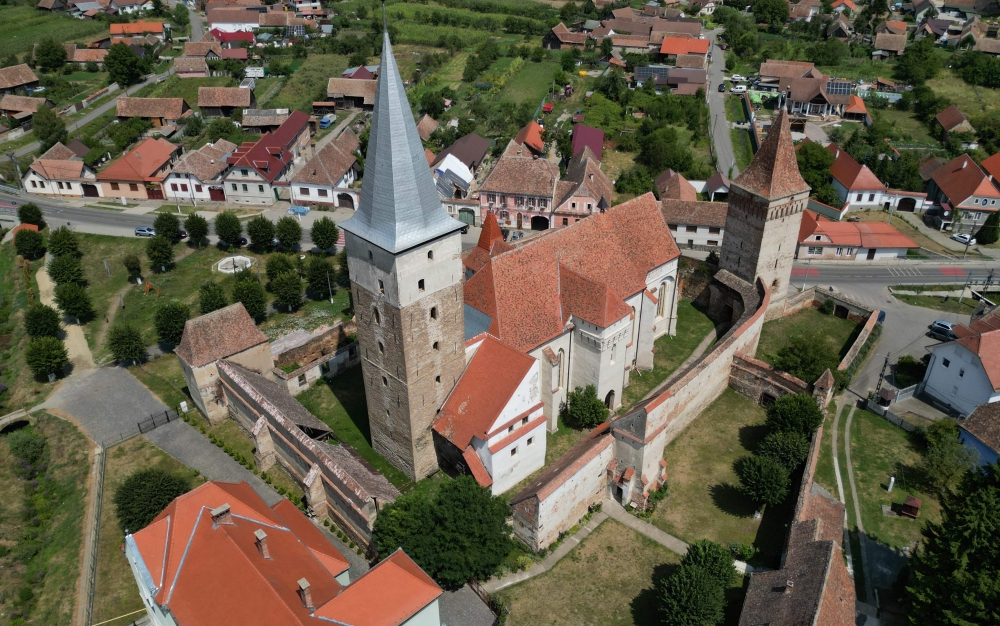
The fortified churches of Transylvania — medieval defensive sanctuaries that have stood for centuries — are crumbling faster than they can be saved. When a section of the outer wall at Mosna’s historic fortified church collapsed silently one night in June 2026, it sent a shockwave through Romania’s heritage community and reignited urgent questions about the future of over 160 similar structures scattered across the region. These architectural treasures, built by the German-speaking Saxon minority during a time of war and displacement, now face a quieter but equally devastating threat: neglect, depopulation, and a chronic shortage of funds.
A Medieval Legacy Left Vulnerable by Mass Exodus
Transylvania’s fortified churches were constructed in the Middle Ages as places of both worship and refuge. Surrounded by thick outer walls and defensive towers, they sheltered local Saxon populations from raids by Tatars and Ottomans in a region that was long contested borderland. Today, more than 160 of these structures survive across Transylvania — but many are in dire condition.
The root cause is demographic. Before World War II, approximately 300,000 Saxons lived in Transylvania. Today, only around 10,000 remain. Generations fled the country during Nicolae Ceauşescu’s communist dictatorship, leaving churches without caretakers and communities without the resources to maintain them. In a country ranked among Europe’s poorest, many of these monuments have simply been left to decay alongside countless other neglected historic buildings.
The village of Mosna illustrates the human dimension of this crisis with particular clarity. Mariana Rempler, 74, is the last woman from the Saxon minority still living there. The church where she was baptised and married now draws roughly 4,000 visitors a year — including Britain’s King Charles III, who visited in 1998 — but the June wall collapse has left her fearing for the tower that remains standing, now propped up by wooden beams installed back in 2017.
“I felt a great pain inside me. It was as if I had collapsed at the same time with that wall,” Rempler told AFP, her account underscoring how deeply these structures are woven into the identities of those who remain.
Restoration Efforts Cover Only Half the Endangered Churches
The scale of the preservation challenge is immense. Cristian Cismaru, manager at the Fortified Churches Foundation, confirmed to AFP that approximately 80 of the roughly 160 fortified churches — including Mosna — have undergone or are scheduled to undergo restoration work within a 35-year window spanning the post-communist era through the next five years.
The Fortified Churches Foundation operates in partnership with the Evangelical Church in Romania, relying on grants and donations to fund repairs. Critically, around 85 per cent of the money comes from the European Union. Without that funding pipeline, even the current pace of restoration would be impossible to sustain.
Yet the arithmetic is sobering. “I don’t think we’ll be able to address the other half of our heritage in our lifetime. That will be left for future generations,” Cismaru acknowledged.
The remaining half — roughly 80 churches — faces an uncertain fate with no restoration timeline in place.
Giving Churches a New Purpose to Ensure Their Survival
Preservation experts and community organisers recognise that financial support alone cannot save structures that have lost their congregations. Cismaru argues that many of the churches need “a new concept for their survival,” since they can no longer function as active places of worship.
One concrete proposal is to repurpose the buildings as cultural spaces — venues for art, music, local history, and heritage tourism. That vision is already gaining traction. Earlier in August 2026, fortified churches across the region hosted dozens of events during Romania’s largest annual festival dedicated to Saxon heritage, drawing a record of nearly 10,000 visitors according to organisers.
At a community brunch Cismaru organised for tourists in the village of Cincsor — located 60 kilometres southeast of Mosna — he explained that one third of every €30 (approximately RM141) entry ticket is donated directly to a local development project. The model demonstrates how heritage tourism can generate tangible community benefit while sustaining the monuments themselves.
“Our role, those of us who live in Transylvania, regardless of nationality, race or religion, is to continue to look after these monuments,” Cismaru said. “We want to breathe new life into these fortified churches.”
The Mosna Collapse as a Wake-Up Call
In Mosna itself, the immediate aftermath of the wall collapse has produced an unexpected effect: visitor numbers have risen. Mayor Dumitru Nutu told AFP that even more tourists now come to see the church following the incident. “I keep seeing them from the town hall window. They’re all taking photos of the broken wall,” he said.
Hundreds of scattered bricks, covered by a plastic sheet, remain piled at the base of the endangered tower. French tourist François Régis, 53, visiting with his wife, described the church as beautiful and well preserved despite the damage to its northern section. “The blend of Gothic and defensive elements is always interesting. All in all, the concept of a fortified church is quite intriguing,” he said.
Rempler, meanwhile, photographs the tower almost daily, documenting its visible cracks in the hope that the evidence will accelerate action. “I’m afraid that in a month or two, that tower won’t still be standing,” she said, noting that the collapsed wall had been providing structural support.
Her hope is that the collapse serves as a turning point. “It would be a shame for us to let it fall into ruin.” — AFP