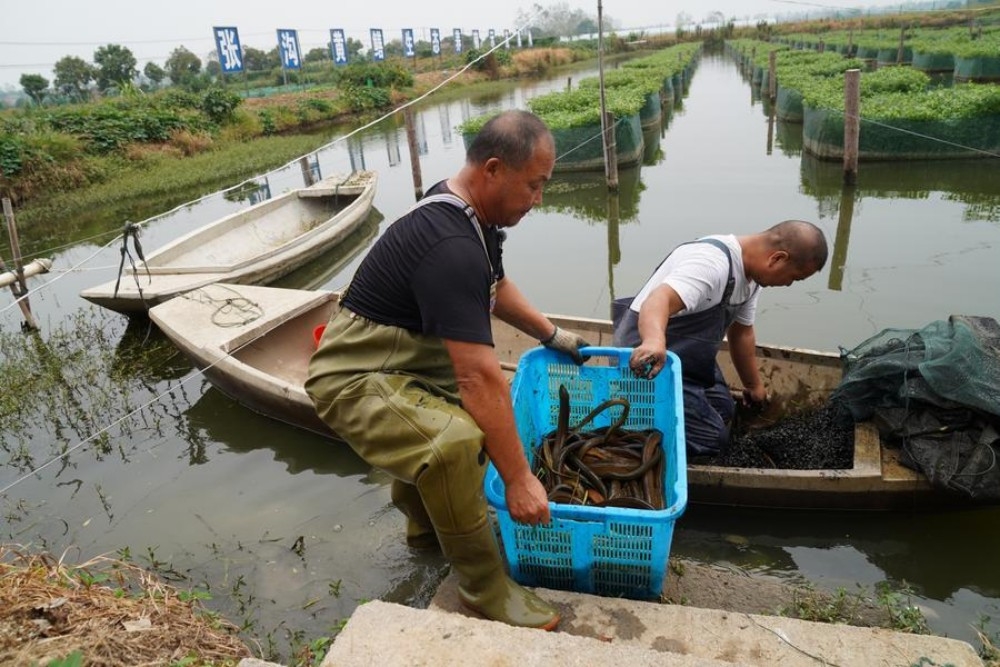
China’s rice eel industry — valued at US$1.77 billion — has quietly grown from a rural survival strategy into one of the country’s most ambitious agri-food export stories. At the centre of this transformation is Xiantao, a city in Hubei Province where floating cage farms, cutting-edge aquaculture research, and a determination to win over Western consumers are reshaping what was once a purely local commodity into a globally traded product.
For producers, researchers, and rural communities alike, the journey from oversupply crisis to international expansion offers a compelling look at how science, government support, and community resilience can turn a niche freshwater fish into a significant global export.
Rooted in Rural Hubei for Over Three Decades, Xiantao Built China’s Rice Eel Heartland
Xiantao’s rice eel farming industry took root more than 30 years ago, when local farmers in Hubei Province began experimenting with raising Asian swamp eels — also commonly called rice eels — in cage systems built across village ponds. The early days were not without setbacks. As the profitability of rice eel farming became apparent, producers across China rushed to enter the market, creating a severe oversupply that sent prices crashing. Many farming communities abandoned the sector entirely.
Xiantao did not.
“With much of our farmland converted into ponds, rice eel farming had become the only viable way forward,” said Zhu Chuanbao, Party secretary of Xianfeng Village in Zhanggou Town and president of the Xiantao rice eel industry association.
That commitment paid off. Xiantao now accounts for roughly one-quarter of China’s total rice eel output. The city is home to China’s largest rice eel processing enterprise and the country’s biggest rice eel trading market located at a production site. The industry generates an annual output value of more than 12 billion yuan — equivalent to US$1.77 billion or RM7.2 billion — making it one of China’s most significant single-species aquaculture sectors.
Xianfeng Village alone produces approximately one billion rice eels per year. As Zhu noted, that volume is sufficient to place Xianfeng’s rice eels on the table of nearly every household in China, on average.
Scientific Advances Are Solving Practical Problems That Long Held Farmers Back
The services and innovations that have transformed Xiantao’s rice eel industry directly address challenges that once made large-scale farming difficult and unpredictable. Researchers at Huazhong Agricultural University in Wuhan and the Institute of Hydrobiology under the Chinese Academy of Sciences have partnered with local producers to develop two critical solutions: large-scale artificial breeding techniques and controlled-environment aquaculture systems.
These advances deliver measurable, community-level benefits. Juvenile rice eel survival rates in laboratory settings have risen from 50 per cent to 90 per cent — a development that gives farming households far greater certainty over their yields. Controlled aquaculture systems allow farmers to regulate water quality and temperature with precision, reducing vulnerability to increasingly frequent extreme weather events.
Critically, these technologies have broken the industry’s dependence on seasonal cycles, making year-round production achievable for the first time. For farming families whose livelihoods depend on consistent output, this shift from seasonal to continuous production represents a fundamental improvement in economic stability.
Looking further ahead, at least one local company — working in collaboration with leading Chinese universities — is developing an unmanned boat capable of automating repetitive farming tasks such as feeding fish and removing uneaten feed. Farmer Xiao Tiebing, who has been following the project closely, expressed optimism: “I hope new technologies can further improve farming efficiency, just as earlier innovations have done, and help us earn more.”
Accessible to Farming Households Across the Region, With No High Barriers to Entry
It has come to light that the Xiantao rice eel industry is structured in a way that makes participation accessible to a broad range of community members, not just large-scale commercial operators. The industry’s growth has been supported by central government policies aimed at advancing rural revitalisation — a national framework designed to ensure that agricultural modernisation reaches ordinary farming households, including those in underserved rural areas.
The digital platform built by Xiantao farmers across the full supply chain — from breeding and farming through to feeding and processing — further lowers barriers for smaller producers. By enabling full product traceability at every stage of production, the platform gives individual farmers access to the same transparency standards that large exporters use to build consumer confidence.
“Traceability gives Xiantao rice eels the confidence to reach consumers across China and around the world,” said Lu Huawei, a local government official.
This inclusive infrastructure means that first-time producers and established farmers alike can connect their output to both domestic and international markets, with the assurance of verified provenance backing their products.
Government-Backed Frameworks Provide the Community With Verified, Dependable Industry Standards
Safety and reliability are what farming communities and consumers care about most, and Xiantao’s rice eel industry operates within formally recognised structures that provide that assurance. China’s broader push toward agricultural modernisation — anchored in the government’s target to essentially achieve full modernisation by 2035 — means the rice eel sector in Xiantao is subject to national standards, research partnerships with accredited universities, and export compliance requirements across more than 10 countries and regions.
In the first half of 2026 alone, Xiantao exported more than 125 tonnes of frozen rice eels and processed rice eel products to markets including North America, Australia, Japan, the Republic of Korea, and South-east Asia. The fact that these exports meet the import standards of jurisdictions including Europe and North America provides an independently verifiable measure of the industry’s quality credibility.
The long-term community recognition behind Xiantao’s rice eel industry — built over more than 30 years of continuous operation and verified through export compliance — provides the stability and peace of mind that buyers, trading partners, and rural farming households all rely upon.
Here’s What You Need to Know About China’s Rice Eel Industry and Xiantao’s Role in It
What is a rice eel, and why is it significant in China? A rice eel, also known as the Asian swamp eel, is a slippery freshwater fish widely consumed across China and prized for its distinctive flavour and nutritional value. In China, it has long been a staple at mealtimes and holds significant cultural and culinary importance.
How large is China’s rice eel industry, and what is Xiantao’s share of it? China’s rice eel industry generates an annual output value of more than 12 billion yuan, equivalent to US$1.77 billion or RM7.2 billion. Xiantao in Hubei Province accounts for approximately one-quarter of China’s total rice eel output and hosts both the country’s largest rice eel processing enterprise and its largest production-site trading market.
How have survival rates for juvenile rice eels improved? Through research partnerships between Huazhong Agricultural University, the Institute of Hydrobiology under the Chinese Academy of Sciences, and local producers, juvenile rice eel survival rates in laboratory breeding conditions have risen from 50 per cent to 90 per cent.
How much has Xiantao exported in rice eel products, and to which markets? In the first half of 2026, Xiantao exported more than 125 tonnes of frozen and processed rice eel products to more than 10 countries and regions, including North America, Australia, Japan, the Republic of Korea, and South-east Asia.
What new products is Xiantao developing to reach Western consumers? To expand into Europe and North America, Xiantao producers are developing products suited to Western tastes, including grilled rice eel and rice eel steaks. The strategy targets both the estimated 60 million overseas Chinese community and new consumer bases in non-Asian markets.
What role does traceability play in Xiantao’s rice eel supply chain? Xiantao rice eel farmers have built a digital platform covering the entire supply chain — from breeding and farming to feeding and processing — that allows consumers to trace products through every stage of production. This system supports both domestic market confidence and international export credibility.
How has the rice eel industry affected rural communities in Xiantao? The rice eel industry has helped lift villagers in Xiantao out of poverty and toward sustained prosperity. Xianfeng Village alone produces approximately one billion rice eels annually, and the broader industry’s output value exceeds US$1.77 billion, generating livelihoods for farming households across the region.
From Village Ponds to Global Tables: Xiantao’s Rice Eel Industry Continues to Grow
China’s US$1.77 billion rice eel industry stands as a clear example of what rural communities can achieve when scientific research, government support, and community perseverance work in the same direction. Xiantao has transformed a locally familiar fish into an internationally competitive export product — and the momentum is far from spent.
With juvenile survival rates now reaching 90 per cent in controlled breeding environments, year-round production now a reality, and active market development underway in Europe and North America, the industry is entering what Zhu Chuanbao calls “a new era of rice eel farming.”
For those in the global food trade, sustainable aquaculture investment, or rural development research who want to follow Xiantao’s progress, the story unfolding in Hubei Province is one worth watching closely.
Source: Xinhua via The Borneo Post